Puzzle 12: What is it? (Guessed)
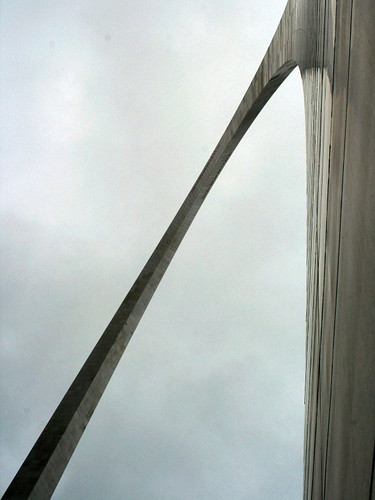
Image by "Caveman Chuck" Coker
What is this object?
This must have been way too easy. Cptdrinian guessed it almost as soon as I had posted it.
When I took this photo I was standing on the west side of the south leg of the Gateway Arch. looking up along the leg. If you look closely, you can see the windows of the observation deck.
Jefferson National Expansion Memorial
11 N 4th Street
St. Louis, MO 63102
(314) 655-1700 — Visitor Information
(877) 982-1410 — Tram Tickets
The National Park Service has a web page which describes Unusual Events and Occurrences at Jefferson National Expansion Memorial. Check it out. It is part of the online book Administrative History: Jefferson National Expansion Memorial National Historic Site 1935-1980 (June 1984).
My favorite story from the book:
On Saturday, November 22, 1980, at approximately 8:55 a.m., Kenneth Swyers of Overland, Missouri, "was seen parachuting above the Gateway Arch. It appeared that Swyers landed on top of the Arch and that he was thrown off balance when the wind caught his parachute. Swyers’ parachute deflated and [he] fell down the North Leg of the Arch. Approximately [half-way] down Swyers attempted to deploy his auxiliary parachute, however it failed to open and Swyers landed on his head on the concrete terrazzo. Swyers was pronounced dead at the St. Louis City Hospital at 0950 hours."
The 33-year-old Swyers requested permission to make a parachute jump in the vicinity of the Arch on August 21, 1980, which was denied by Charles Ross, special assistant to the superintendent. Swyers watched a television program the night before his death which showed daredevil acts of parachute jumping. Swyers was himself a parachute enthusiast who had made more than 1,600 jumps, and on the morning of his death, he left a note for his wife to come to the Arch to photograph his jump. Few park employees or visitors were on the grounds before 9:00 a.m. in late November when Swyers made his jump. Park Technician Lisa Hanfgarn, hurrying to get to work on time, thought she saw an object fall down the North Leg of the Arch as she entered the doors to the complex. She reported this to Seasonal Park Technician Liz Schmidt (of the law enforcement division), who was monitoring the north entrance doors. Schmidt went outside to discover the body of Swyers lying in the midst of his parachutes, and immediately radioed to law enforcement rangers requesting assistance, an ambulance and the city police. Two St. Louis city policemen, who witnessed the jump from Wharf Street, arrived on the scene and documented the fatal injury to Swyers. An ambulance was on the scene by 8:59 a.m. Mr. Swyers’ wife was on the grounds at the time of the accident and saw her husband fall to his death. She came forward at the accident scene, viewing her husband’s body and eventually covering his face with his parachute. A large crowd gathered, composed of visitors, police and medical personnel. Park Technician Schmidt later testified that the weather was blustery, cold and windy, and that it was not a good day for a jump, near the Arch or elsewhere. The FAA was immediately notified, and an investigation eventually turned up the pilot who ferried Swyers over the Arch to make his fatal jump. As a result, Richard Skurat of Overland, Missouri had his pilot’s license suspended for 90 days by the FAA in December 1980.
————————————————————————————————————————
The Gateway Arch, also known as the Gateway to the West, is an integral part of the Jefferson National Expansion Memorial and the iconic image of St. Louis, Missouri. It was designed by Finnish-American architect Eero Saarinen and structural engineer Hannskarl Bandel in 1947. It stands 630 feet (192 m) tall, and is 630 feet (192 m) wide at its base, making it the tallest monument in the United States. Construction of the arch started on February 12, 1963 and was completed on October 28, 1965. The monument opened to the public on July 24, 1967.
Physical Description
The cross-sections of its legs are equilateral triangles, narrowing from 54 feet (16 m) per side at the base to 17 feet (5.2 m) at the top. Each wall consists of a stainless steel skin covering a sandwich of two carbon steel walls with reinforced concrete in the middle from ground level to 300 feet (91 m), with carbon steel and rebar from 300 feet (91 m) to the peak. The interior of the Arch is hollow and contains a unique transport system leading to an observation deck at the top. The interior of the Arch also contains two emergency stairwells of 1076 steps each, in the event of a need to evacuate the Arch or if a problem develops with the tram system.
The base of each leg at ground level had an engineering tolerance of one sixty-fourth of an inch or the two legs would not meet at the top.
During construction, both legs were built up simultaneously. When the time came to connect both legs together at the apex, thermal expansion of the sunward facing south leg prevented it from aligning precisely with the north leg. This alignment problem was solved when the St. Louis Fire Department sprayed the south leg with water from firehoses until it had cooled to the point where it aligned with the north leg.
It is the tallest habitable structure in Missouri, 7 feet higher than the 623 foot spire of One Kansas City Place in Kansas City, and 37 feet higher than the roof of Metropolitan Square in St. Louis, Missouri.
Tram
Eero Saarinen died from a brain tumor four years before the Arch was completed; prior to his death he had decided to incorporate a power lift system to obviate the need to climb the 1000-plus stairs. But the shape of the arch would have made a standard elevator impossible. After approaching several elevator companies who failed to come up with a viable method, Saarinen hired parking-lot elevator designer Richard Bowser to do the job. Skeptical city leaders gave Bowser only two weeks to submit a design, but he succeeded. By 1968, a unique tram system that combined an elevator cable lift system with gimbaled cars functionally similar to ferris wheel gondolas had been installed.
The tram is operated by the quasi-governmental Bi-State Development Agency under an agreement with the NPS.
From the visitor center one may move to either base (one on the north end and the other on the south end) of the Arch and enter the tramway much as one would enter an ordinary elevator, through narrow double doors. The north queue area includes displays which interpret the design and construction of the Gateway Arch; the south queue area includes displays about the St. Louis riverfront during the mid-19th century.
Passing through the doors, passengers in groups of five enter an egg-shaped compartment containing five seats and a flat floor. Because of the car shape, the compartments have sloped ceilings low enough to force taller riders to lean forward while seated (for this reason it’s recommended that the tallest of the five passengers in the car sit in the center seat facing the door). Eight compartments are linked to form a train, meaning that both trains have a capacity of 40, and that 80 people can be transported at one time. These compartments individually retain an appropriate level by periodically rotating every 5 degrees, which allows them to maintain the correct orientation while the entire train follows curved tracks up one leg of the arch. The trip to the top of the Arch takes four minutes, and the trip down takes three minutes. The car doors have narrow windows, allowing passengers to see the interior stairways and structure of the Arch during the trip.
Observation Area
Near the top of the arch, the rider exits the compartment and climbs a slight grade to enter the arched observation area. Thirty-two small windows (16 per side) measuring 7 by 27 inches (180 mm × 690 mm) allow views across the Mississippi River and southern Illinois with its prominent Mississippian culture mounds to the east at Cahokia Mounds, and the City of Saint Louis and St. Louis County to the west beyond the city. On a clear day, one can see up to thirty miles (48 km).
Notable Events
A time capsule containing the signatures of 762,000 St. Louis area students was welded into the keystone before that final piece was set in place.
Eleven light aircraft have been successfully flown beneath the arch, the first on June 22, 1966 when the arch had been completed for less than a year.
In 1984, David Adcock of Houston, Texas, began to scale the arch by means of suction cups on his hands and feet, but he was talked out of continuing after having climbed only 20 feet (6.1 m). The next day he successfully scaled the nearby 21-story Equitable Building in downtown St. Louis.
It was declared a National Historic Landmark in 1987.
On September 14, 1992 it was rumored that John C. Vincent of New Orleans successfully scaled the outside of the Arch with suction cups during the night, and performed a BASE jump from the top with a parachute at 7 a.m. No evidence surfaced to support his claim, and it was speculated by Park Rangers that Vincent was lowered from a helicopter onto the top of the Arch, from which he parachuted. He was jailed three months for the stunt.
On July 21, 2007, approximately 200 people were trapped in the trams or at the top of the Arch after an electrical problem occurred with the tram system. All were returned to the ground either by being taken down stairs to a service elevator, or by waiting for power to be restored. A second electrical problem caused one tram to be taken out of service the following day.
Source: Wikipedia — If you are a glutton for punishment, read Mathematics of the Arch
————————————————————————————————————————
20090921_0110a1_600x800
Tags:Cool, Designer, images, interior


0 comments:
Post a Comment